


Ancient Discovery Along the Smoky River

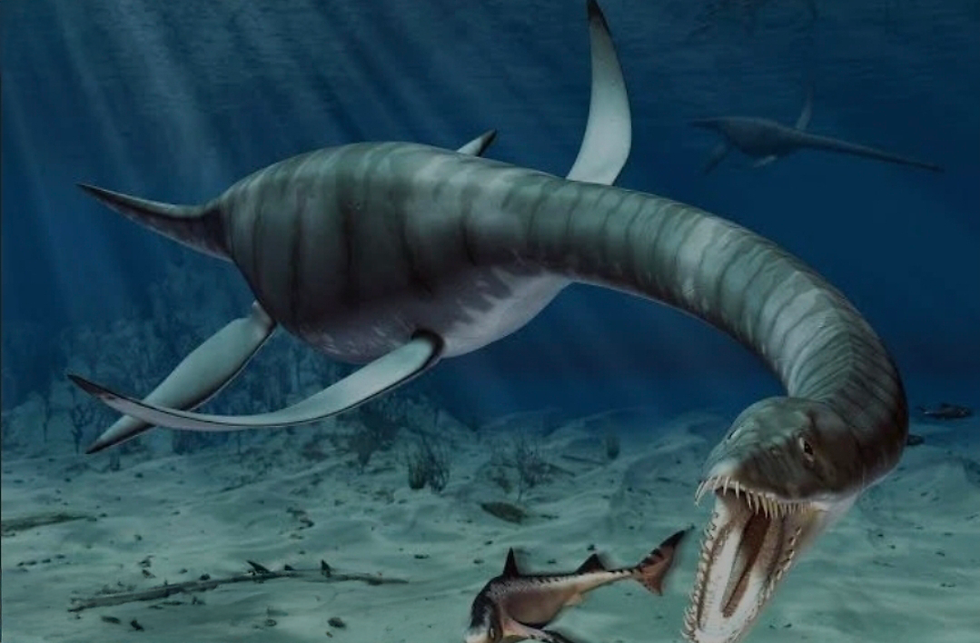
In June 2025, a quiet stretch along the Smoky River in Northern Sunrise County (NSC) became the setting for an extraordinary discovery, one that would capture imaginations across the region and beyond—an estimated 110+ million year old fossilized Plesiosaurus.
When local resident Stéphane Chenard stumbled upon a series of strange, large bones near Murphy’s Flats, he could not have known it would set off a flurry of scientific excitement, community collaboration and logistical challenges.
“Stéphane sent in a few photos to the museum’s fossil report email,” said Dr. Ilaria Paparella, Ph.D., a curator at the Royal Tyrrell Museum. “We receive a lot of these emails, especially in the summer, but this one immediately stood out. The bones were large, distinct and something unmistakably special.”
Within days, experts from the Royal Tyrrell Museum and the Philip J. Currie Dinosaur Museum began mobilizing.
At the same time, Alberta Parks officials were alerted to the urgency of the find—the bones lay dangerously close to the river’s edge, at risk of erosion or loss to the current. This is when Nikki Homberger, 36, land management specialist with Department of Forestry and Parks, enters the story.
“I got the call that there was a significant fossil discovery right along the water,” said Homberger. “Because of how close it was to the Smoky River, there was a real risk of the bones being washed away. We had to move quickly.”
A resident of Peace River, Homberger’s familiarity with the region proved invaluable. She reached out to colleagues at Alberta Parks to expedite the necessary permit, which is a process that usually takes weeks.
“I was able to flag it as ‘urgent’ right away. Within 24 hours, the permit to excavate was granted. Everyone understood how special this was,” said Homberger. “Then, I assisted the team with field recon and operational planning.”
Homberger notes that collaborating with various other government staff and districts, the museums, local businesses and Northern Sunrise County was imperative to the successful recovery.
Initially, navigating the rugged terrain and unpredictable river conditions was no small feat for Dr. Paparella and her team. Access was remote.
“We brought our own boat,” said Dr. Paparella. “But once we got to the Smoky River, we realized very quickly our boat wasn’t going to cut it. We needed a jet boat. Thankfully, locals came to our rescue.”
A local company that offers boat tours and operates a campground, Peace River Adventures, stepped in to help, providing not only the right equipment but also their knowledge of the waterway.
“They literally saved us a few times,” said Dr. Paparella. “Without them, we might still be stuck out there.”

Co-owner of Peace River Adventures Alana Bergeron says they were happy to help provide river transportation for the crew to and from the dig site.
“We are so grateful to have been part of such a historic moment for the Peace Region,” said Bergeron. “One of the highlights was taking our home-schooled twins to the dig site where they got to learn firsthand about the ancient discovery and even hold one of its vertebrae. It was an unforgettable experience.”
Despite challenges, the team successfully retrieved the bones, and what they found was astonishing. The remains belonged not to a dinosaur but to an ancient Plesiosaur, a marine reptile that swam Alberta’s prehistoric seas roughly 110 million years ago.
“These creatures weren’t dinosaurs,” said Dr. Paparella. “They were large marine reptiles with long necks, small heads and flippers, the kind of animal that might remind people of the Loch Ness monster.”
The specimen was remarkably well preserved, with much of its neck, ribs, hips and flippers intact.
“We think we have most of the body,” said Dr. Paparella. “We’re missing the skull, but we’re
hopeful it’s still there in the rock or maybe a bit deeper in the riverbank.”
Once transported to the Royal Tyrrell Museum, the bones were placed in plaster jackets for safekeeping. The next step is a painstaking process known as preparation, which involves carefully removing the surrounding rock and stabilizing the bones for study.
“It’s slow, detailed work,” said Dr. Paparella. “We use special adhesives that can be reversed later if needed. The goal is to preserve the fossil for future generations while learning as much as we can about its life and environment.”
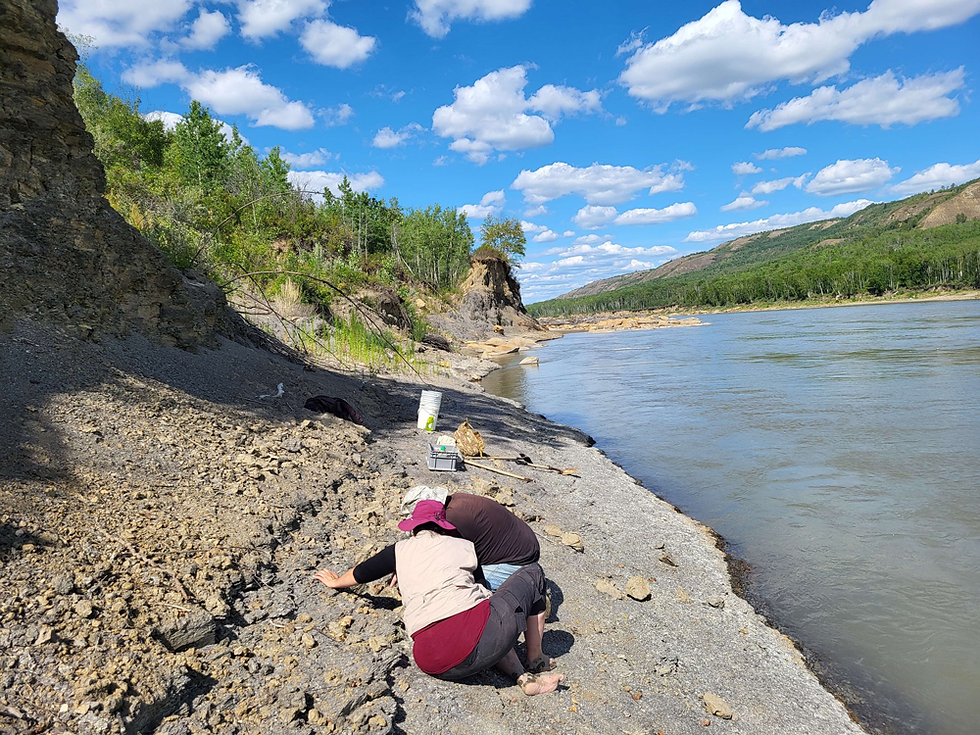
For Homberger, being part of the recovery was more than a professional milestone, it was a personal adventure.
“It was definitely the highlight of my summer,” said Homberger. “We were out there in the mud and water, pulling boats, planning logistics and just making it happen. I felt an enormous sense of pride, not only in the discovery but in how our local community came together to help.”
From residents lending a hand to government departments working in tandem, the discovery became a testament to Northern Sunrise County’s spirit of collaboration.
“With every obstacle we faced, someone was ready to step up with a solution,” said Homberger. “It was an amazing example of what happens when people care about something bigger than themselves.”
Dr. Paparella agrees.
“The sense of welcome from the community was incredible,” she said. “People who had never met us were helping how ever they could—from offering places to stay to towing us out of the river. It made the whole experience unforgettable.”
Back at the museum, researchers continue their work analyzing the specimen and its surrounding rock layers, which may offer new insights into Alberta’s prehistoric past.
In Northern Sunrise County, the enthusiasm is far from over.
“This exciting discovery near Murphy’s Park has definitely sparked the wonder and curiosity of our residents and neighbours alike,” said NSC Reeve Corinna Williams. “It brings out the child’s imagination in all of us as we wonder what else nature has to offer us right here in Northern Sunrise County.”
From the muddy shores of the Smoky River to the pristine labs of the Royal Tyrrell Museum, this discovery is more than just a window into ancient life, it’s a story of curiosity, teamwork and the enduring power of discovery that has the ability to unite science and community.
For inquiries, or to report a fossil/artifact discovery, visit albertaparks.ca
By Amanda Hunter Photography submitted by the Royal Tyrrell Museum of Paleontology and Alana Bergeron


Comments